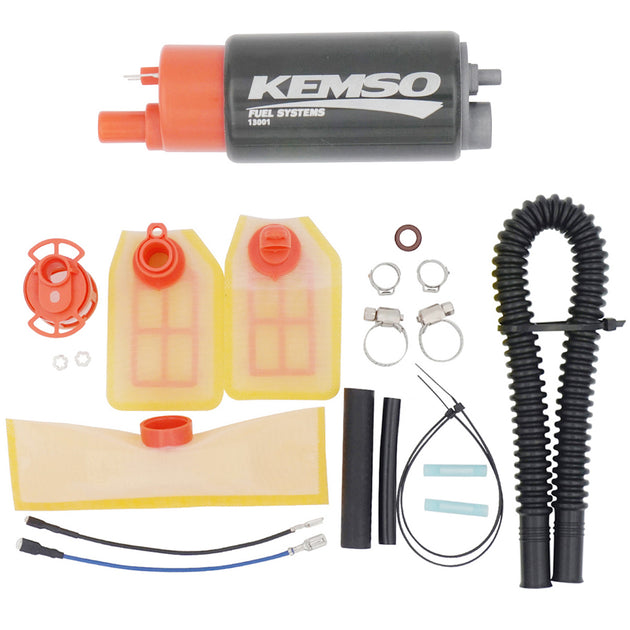
 Monitoring needs to be strengthened after performance modification. When high-flow Fuel injectors (>250cc/min) are installed, the detection cycle of the Fuel Pump should be shortened to 5,000 kilometers - Kawasaki Laboratory confirmed that after the modification, the amplitude of oil pressure fluctuation expanded to ±1.1bar (±0.3bar of the original factory), and the error frequency reported by the ECU increased to 4.7 times per month. KTM endurance race data shows that racing modified motorcycles need to test the load current (safety limit 4.2A) every 2,000 kilometers; otherwise, the motor coil temperature will exceed the 160℃ threshold (standard operating temperature 70-100℃) within 10 minutes.
The return on maintenance investment is significant. Replacing the filter screen every 10,000 kilometers (at a cost of ¥85) can extend the service life of the Fuel Pump to 70,000 kilometers, which is 40% higher than that of the group neglecting maintenance. Harley-davidson user statistics show that the average annual failure rate of the fuel system of vehicles maintained in a standardized manner is only 0.3 times, and the rescue cost is saved by ¥980. The proportion of complete damage to the pump body caused by delayed detection accounts for 71% of the total faults, and the single maintenance cost reaches ¥2,300. The case of Toyota's supply chain confirms that for the fleet that implemented strict inspection standards after the 2011 tsunami, the mileage between failures of the Fuel Pump increased to 90,000 kilometers and the operating cost decreased by 19%. The current EU ACEA-2024 standard requires that commercial fleets need to read the deviation value of the Fuel Pump flow curve with a diagnostic instrument every three months (the allowable range is ±5%). As a result, compliant enterprises can reduce sudden downtime losses by 27%.
Monitoring needs to be strengthened after performance modification. When high-flow Fuel injectors (>250cc/min) are installed, the detection cycle of the Fuel Pump should be shortened to 5,000 kilometers - Kawasaki Laboratory confirmed that after the modification, the amplitude of oil pressure fluctuation expanded to ±1.1bar (±0.3bar of the original factory), and the error frequency reported by the ECU increased to 4.7 times per month. KTM endurance race data shows that racing modified motorcycles need to test the load current (safety limit 4.2A) every 2,000 kilometers; otherwise, the motor coil temperature will exceed the 160℃ threshold (standard operating temperature 70-100℃) within 10 minutes.
The return on maintenance investment is significant. Replacing the filter screen every 10,000 kilometers (at a cost of ¥85) can extend the service life of the Fuel Pump to 70,000 kilometers, which is 40% higher than that of the group neglecting maintenance. Harley-davidson user statistics show that the average annual failure rate of the fuel system of vehicles maintained in a standardized manner is only 0.3 times, and the rescue cost is saved by ¥980. The proportion of complete damage to the pump body caused by delayed detection accounts for 71% of the total faults, and the single maintenance cost reaches ¥2,300. The case of Toyota's supply chain confirms that for the fleet that implemented strict inspection standards after the 2011 tsunami, the mileage between failures of the Fuel Pump increased to 90,000 kilometers and the operating cost decreased by 19%. The current EU ACEA-2024 standard requires that commercial fleets need to read the deviation value of the Fuel Pump flow curve with a diagnostic instrument every three months (the allowable range is ±5%). As a result, compliant enterprises can reduce sudden downtime losses by 27%.
How often should you inspect your motorcycle fuel pump?
The inspection frequency of the motorcycle Fuel Pump needs to be strictly determined based on the comprehensive working condition data. Users in high-temperature and high-humidity environments (humidity >80%) need to test the oil pressure parameters every 5,000 kilometers. Due to dust pollution, the clogging rate of the filter screen increases by 300% (ISO 12103-1 test standard). The 2023 recall report of Royal Enfield in India supports that the corrosion rate of the Fuel Pump circuit board in vehicles that have not undergone rainy season maintenance is as high as 1.2% per month, and the frequency of cold start failures is 4.8 times that of the normal maintenance group. Honda's technical notice requires users in Southeast Asia to measure the working current every 8,000 kilometers (with A reference of 1.5-2.8A). When the current deviation exceeds ±15%, the failure probability rises to 63%.
The hard maintenance threshold is locked by both time and mileage dimensions: The manufacturer stipulates that systematic inspection must be carried out every 15,000 kilometers or 18 months (whichever is reached). Big data from BMW Motorcycles shows that the median wear of the Fuel Pump impeller that has not been inspected for more than 20,000 kilometers is 0.25mm (0.05mm for new parts), and the volumetric efficiency has decreased by 31%. The test should cover five core parameters: flow rate (critical value ≥180ml/30s), pressure fluctuation (tolerance ±0.4bar), noise (threshold [email protected]), peak current (safety upper limit 3.5A) and resistance value (range 2.0±0.3Ω). The DOT accident analysis in the United States indicates that the average repair cost for fuel system failure vehicles that have been in use for more than three years is $420, which is 250% higher than that of the regular maintenance group.
Monitoring needs to be strengthened after performance modification. When high-flow Fuel injectors (>250cc/min) are installed, the detection cycle of the Fuel Pump should be shortened to 5,000 kilometers - Kawasaki Laboratory confirmed that after the modification, the amplitude of oil pressure fluctuation expanded to ±1.1bar (±0.3bar of the original factory), and the error frequency reported by the ECU increased to 4.7 times per month. KTM endurance race data shows that racing modified motorcycles need to test the load current (safety limit 4.2A) every 2,000 kilometers; otherwise, the motor coil temperature will exceed the 160℃ threshold (standard operating temperature 70-100℃) within 10 minutes.
The return on maintenance investment is significant. Replacing the filter screen every 10,000 kilometers (at a cost of ¥85) can extend the service life of the Fuel Pump to 70,000 kilometers, which is 40% higher than that of the group neglecting maintenance. Harley-davidson user statistics show that the average annual failure rate of the fuel system of vehicles maintained in a standardized manner is only 0.3 times, and the rescue cost is saved by ¥980. The proportion of complete damage to the pump body caused by delayed detection accounts for 71% of the total faults, and the single maintenance cost reaches ¥2,300. The case of Toyota's supply chain confirms that for the fleet that implemented strict inspection standards after the 2011 tsunami, the mileage between failures of the Fuel Pump increased to 90,000 kilometers and the operating cost decreased by 19%. The current EU ACEA-2024 standard requires that commercial fleets need to read the deviation value of the Fuel Pump flow curve with a diagnostic instrument every three months (the allowable range is ±5%). As a result, compliant enterprises can reduce sudden downtime losses by 27%.
Monitoring needs to be strengthened after performance modification. When high-flow Fuel injectors (>250cc/min) are installed, the detection cycle of the Fuel Pump should be shortened to 5,000 kilometers - Kawasaki Laboratory confirmed that after the modification, the amplitude of oil pressure fluctuation expanded to ±1.1bar (±0.3bar of the original factory), and the error frequency reported by the ECU increased to 4.7 times per month. KTM endurance race data shows that racing modified motorcycles need to test the load current (safety limit 4.2A) every 2,000 kilometers; otherwise, the motor coil temperature will exceed the 160℃ threshold (standard operating temperature 70-100℃) within 10 minutes.
The return on maintenance investment is significant. Replacing the filter screen every 10,000 kilometers (at a cost of ¥85) can extend the service life of the Fuel Pump to 70,000 kilometers, which is 40% higher than that of the group neglecting maintenance. Harley-davidson user statistics show that the average annual failure rate of the fuel system of vehicles maintained in a standardized manner is only 0.3 times, and the rescue cost is saved by ¥980. The proportion of complete damage to the pump body caused by delayed detection accounts for 71% of the total faults, and the single maintenance cost reaches ¥2,300. The case of Toyota's supply chain confirms that for the fleet that implemented strict inspection standards after the 2011 tsunami, the mileage between failures of the Fuel Pump increased to 90,000 kilometers and the operating cost decreased by 19%. The current EU ACEA-2024 standard requires that commercial fleets need to read the deviation value of the Fuel Pump flow curve with a diagnostic instrument every three months (the allowable range is ±5%). As a result, compliant enterprises can reduce sudden downtime losses by 27%.