Six Questions That Separate a Cable Maker From a Trader
A trader can forward your drawing to somebody else's factory; a maker has to answer for the extruder. The quickest way to tell the two apart is to ask for named, published evidence — and KUKA CABLE gives a buyer six places to start, beginning with a speciality cable laboratory established in December 2015.
Key takeaways
- A maker can name its own laboratory; this one dates from December 2015 and is described as an ISO/IEC 17025 laboratory.
- A maker can name the standards it tests to: TUV 2PfG 1169/08.2007, EN 50618:2014 and IEC 62930 on the 1500 V solar cable page.
- A maker publishes a cross-section table — 4 mm² at 56 strands of 0.29 mm, weighing 59 g/m — instead of a single headline size.
- Neither a maker nor a trader publishes MOQ, prices or lead times here, so those stay on your quotation sheet, not the website.
Question one: whose laboratory signs the report?
Ask where the cable was tested and who owns the bench. The company's speciality cable laboratory opened in December 2015 and the site describes it as an ISO/IEC 17025 laboratory. It publishes a list of tests that runs through water resistance, UV accelerated weathering, abrasion, cold bending, cold elongation, tensile testing after ageing, solderability, static flexibility, and construction and dimensional checks. A supplier that outsources everything has to send you a third party's report with somebody else's sample numbers on it. KUKA CABLE also states that its cables are tested in leading laboratories for mechanical and electrical properties, so the in-house bench is not presented as the only route to a figure.
Follow that with a second part: who keeps the samples? The company's SIF quality model includes sample retention and traceability alongside raw-material selection, digital control during manufacturing, and inspection of finished products.
Question two: who controls the compound?
The insulation and the sheath on the 1500 V solar cable are XLPO, electron-beam cross-linked and LSHF, on a tinned copper conductor that is class 5 flexible according to IEC 60228. Those four decisions — compound family, cross-linking method, halogen content, conductor plating — determine most of what the cable will do over a 25-year-plus service life. A trader quotes a size and a colour. A maker can explain why the compound is cross-linked by electron beam rather than by heat alone, and why the conductor strands are tinned.
Ask for the construction in numbers. For 6 mm² the published build is 84 strands of 0.29 mm with a nominal overall diameter of 6.0 mm and a nominal weight of 78 g/m. Most sales pages leave cable solar standing for a size and a colour; the manufacturer's own data spells out compound family, plating and strand count instead. If the answer you get is a size label with no strand count, you are not talking to the extruder.
Question three: which standard is the cable tested against?
Names matter here. The 1500 V solar cable page lists TUV 2PfG 1169/08.2007, EN 50618:2014 and IEC 62930. The wider certificates page states more than 30 types of certificates such as TUV, IEC, CE, SAA and UL, and the site describes TUV certification as the starting point, with certified cables expected to keep performance stable for more than 25 years. The common certification set the client highlights for PV cable is TUV EN 50618 / PV1-F, UL 4703 and IEC 62930, with CPR fire rating and AD8 waterproofing called out as regional requirements.
A useful follow-up is blunt: which of those standards does the quoted item actually hold, and can the certificate be downloaded today? The site carries a certificate list and a company record that names the timeline behind it, and it offers a downloadable catalogue and data sheets.
Question four: what happens to a finished drum?
Inspection is the simplest question to ask and one of the hardest to fake. The published answer is 100% inspection of finished products for electrical, mechanical and environmental performance. The product page adds two process numbers: a 10 kV spark test during production, and a 6.5 kV AC test at 50 Hz for 5 minutes on the finished cable. Rated voltage is DC 1.8/1.8 kV.
Ask what a reject triggers. A maker with its own line can describe how a drum is pulled and re-tested; a trader usually has to ask the factory, which is itself an answer.
Question five: how wide is the range, and for how long?
The company timelines say something a trading office cannot copy. August 2012 founded, December 2012 first factory built, December 2015 laboratory established, March 2016 supplied to more than 70 countries, August 2018 PV division becomes independent, June 2021 wire harness processing base established, March 2023 national high-tech enterprise, May 2023 new factory completed. The facility in Jinshan District covers more than 7,000 m², and the site states that core team members all have more than 10 years of experience in cable manufacturing and international trade.
Product range is the other half of the test. Beyond solar cable and connectors, the client lists robot cable, boundary wire, battery cable, welding cable, marine cable, automotive wire, submersible cable, earth cable, power cable, power cord, industrial cable, special cable, floating cable, tether cables, energy storage cable and medium-voltage cable. A narrow catalogue is not proof of anything by itself, but a manufacturer with its own extrusion capacity tends to sell more than one thing.
Question six: who is accountable after the drum arrives?
The company describes a one-stop butler service in which a product consultant stays responsible for the whole process, from enquiry through delivery to post-maintenance. It publishes free samples on product pages, a customised services page and a logistics page, and lists warehouses or offices in the United Kingdom (Blackley, Manchester), Spain (Logroño), Indonesia (Tangerang) and Australia (QLD, VIC, NSW, WA and SA), with the head office in Shanghai.
Ask for the name of the consultant, not the name of the desk. Then ask what happens if the invoice and the datasheet disagree — that question separates a service model from a sales line.
| Question | Published evidence offered | Site location |
|---|---|---|
| Who tests the cable? | Speciality cable laboratory, December 2015, described as ISO/IEC 17025 | Laboratory overview and test list |
| What is the build? | Tinned copper class 5 to IEC 60228, XLPO insulation and sheath, electron-beam cross-linked, LSHF | 1500 V solar cable page |
| Which standards apply? | TUV 2PfG 1169/08.2007, EN 50618:2014, IEC 62930; more than 30 certificate types on the certificates page | Product and certificates pages |
| What inspection runs? | 100% inspection of finished products; 10 kV spark test; 6.5 kV AC for 5 minutes | Product page and quality model text |
| Who handles the order? | One-stop butler service with a named product consultant | Services page |
| What is not published? | MOQ, unit prices, lead times and warranty terms | Absent from the site |
Worked example: turning six questions into a scorecard
Give each question a score of 1 where the supplier produces a document and 0 where the answer is a sentence. A maker with a laboratory, a standard name, a cross-section table and an inspection regime usually reaches 5 or 6; a trader typically manages 2. Multiplying nothing by anything produces nothing, so treat the total as a filter rather than a rating. My own scoring, not a published metric.
One more piece of arithmetic helps when two suppliers quote different sizes. Divide the nominal weight by the cross-section: the published 4 mm² figure of 59 g/m gives about 14.8 g/m per mm², and the 6 mm² figure of 78 g/m gives about 13 g/m per mm² (my own calculation from the manufacturer's table). The heavier conductor build is not proportionally heavier, which is worth knowing when a freight bill is calculated on drum weight.
What the temperature chart does not tell you
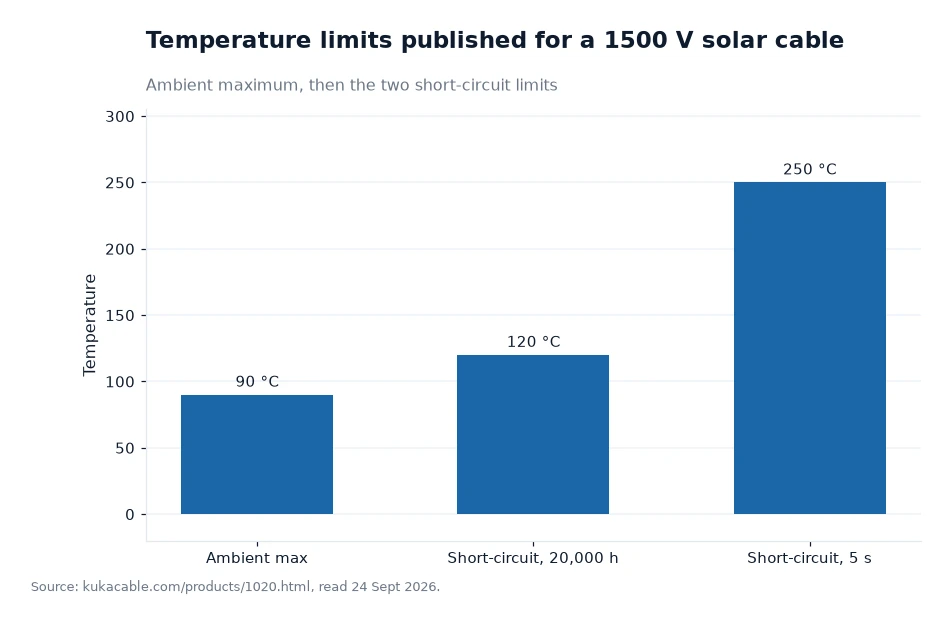
The chart below is the manufacturer's published temperature data for its 1500 V solar cable, and it is a useful sanity check on question four rather than a verdict on the supplier. It shows 90 °C as the ambient maximum, 120 °C as the short-circuit temperature held for 20,000 hours, and 250 °C as the short-circuit temperature allowed for 5 seconds. A quotation that cannot be traced back to numbers like these is quoting a description, not a cable.
Frequently asked questions
What is the single fastest test of whether a supplier is a manufacturer?
Ask for the strand count and the nominal weight of the size being quoted. A manufacturer publishes both next to the cross-section, as this one does for 4 mm² at 56 strands of 0.29 mm and 59 g/m, and a trader normally has to go and find them.
Does a longer certificate list mean a better cable?
No. The site lists more than 30 certificate types including TUV, IEC, CE, SAA and UL, which shows breadth of compliance rather than performance. Check the specific standard named on the datasheet for the item you are buying.
How to use the six questions in practice
Send all six in one email and give the supplier a fixed date to reply in writing. Ask for the laboratory name behind the UV and elongation figures, the cross-section table for every size quoted, the standard and certificate for each item, the inspection routine at the end of the line, the experience of the team that will handle the order, and the name of the consultant who owns it afterwards. Where the website is silent — MOQ, unit prices, lead times and warranty terms are not published here — say so on the enquiry and let the answer become part of the record. KUKA CABLE's own summary of its position is a facility of more than 7,000 m² in Jinshan District, Shanghai, customers in more than 120 countries, and a team whose core members each bring more than a decade to the work; your job is to make a supplier prove each of those claims, one document at a time.
Every answer above rests on the manufacturer's own website figures, and the temperature limits quoted in the questions were filed 24 Sept 2026[1].